
Chapter 9. Census pages, newspapers, journals and county histories
On March 19, 1854, three days after Daniel Murphy finished surveying the section lines around what is now the Sullivan tree farm, John Johnson married Phebe Taylor. She was the daughter of his neighbor James Taylor, and Johnson's sister was Taylor's second wife, which made the groom step-uncle to his own bride.1 That story comes from records compiled by volunteers, who quote the county's marriage record. None of it is in the survey notes or the patents.
Surveys and patents are filed by place. The records in this chapter are filed by name and date: the census, newspapers, journals and letters, and county histories. They put people on the land.
The census
What it tells you. The census shows who lived on or near a property every ten years: names, ages, birthplaces and occupations. In some years it also says whether a family owned or rented and whether it lived on a farm.2 The page in Figure 9.1 was written on June 22, 1880, in the Luckiamute and Buena Vista precincts of Polk County.3
Where to find it. Census pages from 1790 through 1950 are open to the public. Each census is released 72 years after it was taken, so the 1950 census was released on April 1, 2022.4 Most of the 1890 census was destroyed after a fire in 1921.2 FamilySearch has the pages free with a free account, and many public libraries offer the large commercial genealogy sites free to their users. The National Archives' own 1950 census website is free and searchable by name or by location.5
How to read it. Search for a known owner in the census nearest the years that person owned the land. Open the image of the page, not only the typed index. Then read the families listed above and below. Census takers went door to door, and the numbers in the first columns give the order of the visits, so the families around yours were usually the neighbors.2 Copy the enumeration district, the census taker's assigned area, and the page number with every entry, so you can find the page again.3
A caution. A census records where people lived, not what they owned. Names were often misspelled, and an age in one census may not fit the next.6
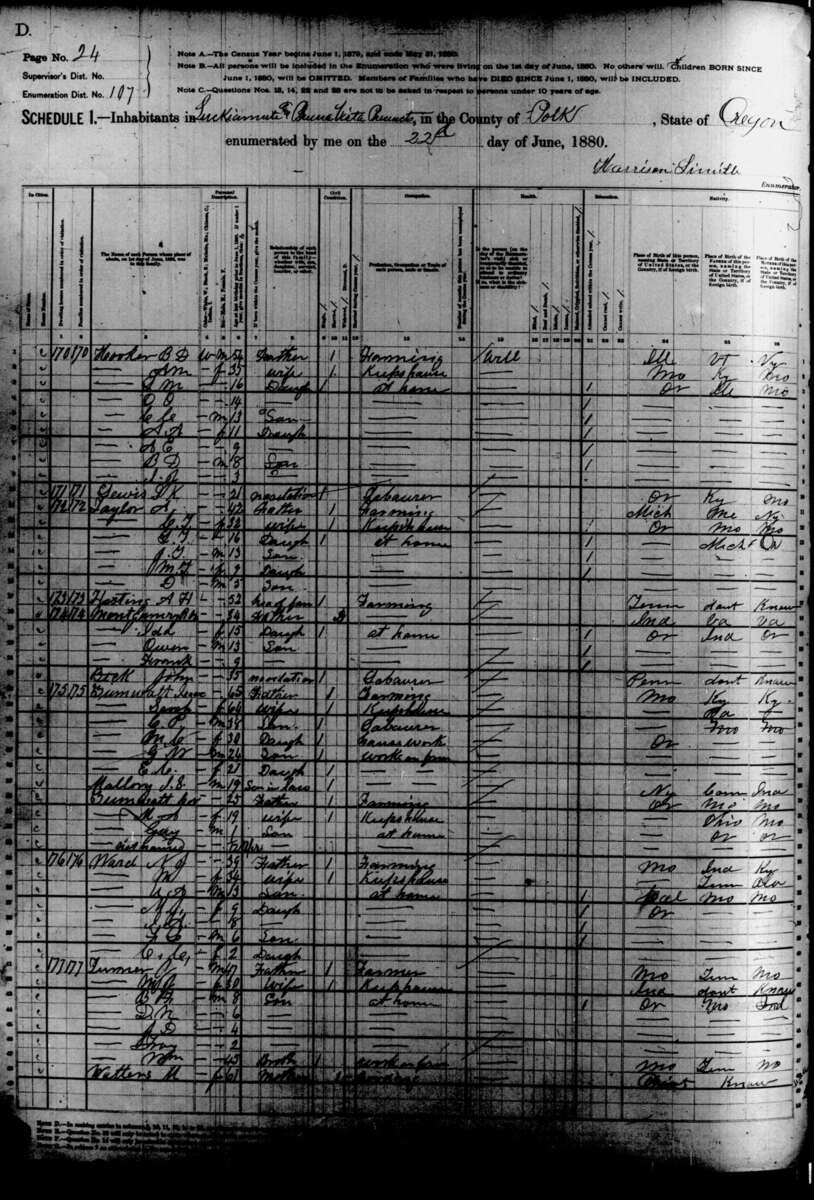
Figure 9.1. A page of the 1880 census for the Luckiamute and Buena Vista precincts of Polk County. The census taker visited these households on June 22, 1880, and numbered them in the order of the visits, in the first columns at the left. Read across a line for each person's age, relationship to the head of the household, occupation, and the birthplaces of the person and both parents. U.S. Census of 1880, Polk County, Oregon, enumeration district 107, page 24. National Archives microfilm T9, roll 1083. Public domain.
Newspapers
What it tells you. Newspapers carry sales, fires, floods, new roads, school news, obituaries, and the small notices that put a date on an event.7 In May 1905 the Polk County Observer of Dallas printed what the editor of a Portland lumber paper had seen in the county's sawmills and logging camps. One line reads: "Phy Simpson, of Pedee, is getting out 4,000,000 feet of logs on the Big Luckiamute" (Figure 9.2).8
Where to find it. Historic Oregon Newspapers, from the University of Oregon, is free. It holds more than 3.5 million pages from 1846 to 2026, among them papers from Dallas, Independence, Monmouth, Falls City, Corvallis and Albany.9 Chronicling America, now part of the Library of Congress website, covers the whole country, and other states have programs of their own.7
How to read it. The search depends on a computer's reading of old print, and it misses words. Try every spelling of every name. The 1938 interview quoted in Chapter 18 spells the town "Peedee."10 Then browse the issues around a known date, page by page.7
A caution. A notice shows that someone reported something on a certain date. Check it against another record before you build on it.
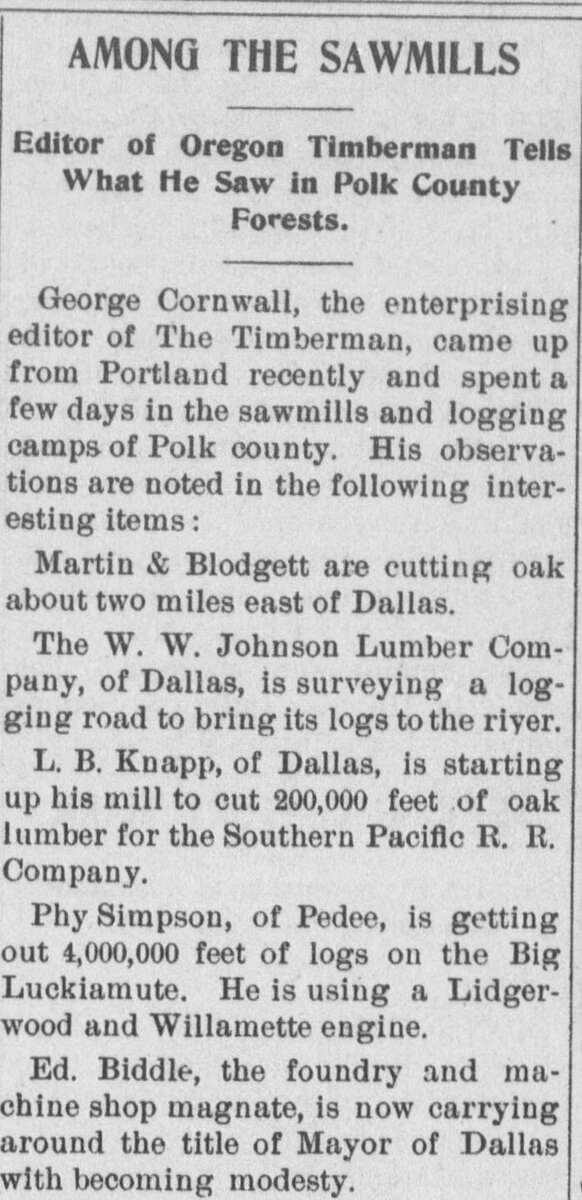
Figure 9.2. Logging news from Pedee, 1905. A Dallas weekly printed what the editor of The Timberman, a lumber paper from Portland, saw in the sawmills and logging camps of Polk County. The fourth item reads: "Phy Simpson, of Pedee, is getting out 4,000,000 feet of logs on the Big Luckiamute." A notice this small can put a date on a logging operation. Polk County Observer (Dallas, Oregon), May 26, 1905, "Among the Sawmills." Historic Oregon Newspapers, University of Oregon. Public domain.
Journals, diaries and letters
What they tell you. A journal tells what one person saw, close to the time it happened: the first sight of a valley, a flooded crossing, a hard winter. For the years before the first survey, an eyewitness journal may be the only written description of a place.11
Where to find them. Published journals of explorers, missionaries and emigrants are in libraries, and many older editions are free at the Internet Archive and HathiTrust. Unpublished ones are at state historical societies such as the Oregon Historical Society, in university special collections, in county museums and in family attics.11
How to read them. Search by the name of your river, your valley or the nearest early settlement. Copy the passage, the date it was written and where the writer was, as nearly as you can tell. Ask who was writing and whether that person saw the thing or heard about it. Then look for the same place in the survey notes and in what people remember. Where a journal, a survey note and a remembered account agree, you have three kinds of evidence for one fact.11 Chapter 21 shows that weighing done across a whole mountain range.
County histories
County, town and family histories give names and stories that make other records easier to find. Many older ones are free at the Internet Archive and HathiTrust. Treat what they say as a lead to check. In the county histories of the 1880s to the 1910s, families often paid to be included.12
What it costs
Almost nothing. The census, the newspapers and the old county histories are free online, the census with a free FamilySearch account. An unpublished diary costs a visit to the archive that keeps it, or a copy fee.
A caution
Records filed by name find people, not acres. A census page puts a family in a precinct, and a newspaper puts a logger "on the Big Luckiamute." Neither says which land. Tie each name to the ground through a patent, a deed or a survey before it goes into your history.
On the tree farm
The people of the farm's first years are known mostly through volunteer-compiled cemetery records. They describe a John J. Johnson buried near Pedee, born in New York in 1816, a farmer who died in 1877, the year his claim's patent was issued. A census entry they quote gives him an age that does not fit.13 That he is the John Johnson of Claim 53 is an inference, though a strong one.13 A great-niece's interview of 1938 remembers him as "captain of the train"; Chapter 18 gives her words in full.14 The Tedrows are harder to follow. One family account says J. W. and Rachel Tedrow, both born in Ohio, came over the Oregon Trail in 1852 and were in Douglas County by 1860. An online family tree has them marrying in Ohio, where the family account says Illinois. Neither has been checked against a record.15 The claimants' own sworn statements, in the donation claim files on FamilySearch, should settle the marriage and confirm which John Johnson held Claim 53.16
Notes
- Polk County Pioneer Cemeteries, Taylor Cemetery records (volunteer-compiled), quoting the 1854 marriage record, as read in A History of the Land (2026), "The Johnsons."
- Zybach, B., How to Research Your Land's History, review draft, October 7, 2026, "Census records."
- U.S. Census of 1880, Polk County, Oregon, Luckiamute and Buena Vista precincts, enumeration district 107, p. 24, National Archives microfilm T9, roll 1083.
- National Archives, census research page and 1950 census website, checked October 10, 2026.
- Zybach, review draft, "Census records"; National Archives, 1950 census website, checked October 10, 2026.
- Zybach, review draft, "Census records"; A History of the Land (2026), "The Johnsons."
- Zybach, review draft, "Newspapers."
- "Among the Sawmills," Polk County Observer (Dallas, Oregon), May 26, 1905, Historic Oregon Newspapers.
- Historic Oregon Newspapers, University of Oregon Libraries, site text, checked October 10, 2026; Zybach, review draft, "Newspapers."
- Interview of 1938, as quoted in Polk County Pioneer Cemeteries, Taylor Cemetery records; A History of the Land (2026), "The Johnsons."
- Zybach, review draft, "Journals, diaries, and letters."
- Zybach, review draft, "Local histories."
- Polk County Pioneer Cemeteries, Taylor Cemetery records; A History of the Land (2026), "The Johnsons."
- Interview of 1938, as quoted in Polk County Pioneer Cemeteries, Taylor Cemetery records.
- McFall, Tedrow family note, as quoted at michaelkluckner.com; WikiTree, "John Wilson Tedrow"; both as read in A History of the Land (2026), "The Tedrows," which treats them as unverified.
- A History of the Land (2026), "Next steps for this property" (National Archives microfilm M815, Oregon City certificates 4751 and 4753).