
Chapter 9. The people before the surveyors
Part 2. Reading your report.
People lived on every piece of Oregon for thousands of years before a surveyor set a post there. This part names them.
What it says. The people of the valley, the treaty by which the land passed to the United States, and the nations today; at Full, the councils, the removals and the people the records name.
Where the facts come from. The treaties as printed in Charles Kappler's Indian Affairs: Laws and Treaties, the U.S. Forest Service's map of the lands ceded by each treaty, and published histories of the valley.
What to notice. Names are spelled as each document spelled them. The part works at the scale of the valley or the river and never shows a village, a camp or a burial on a map. The tribes exist today and are the authority on their own histories.
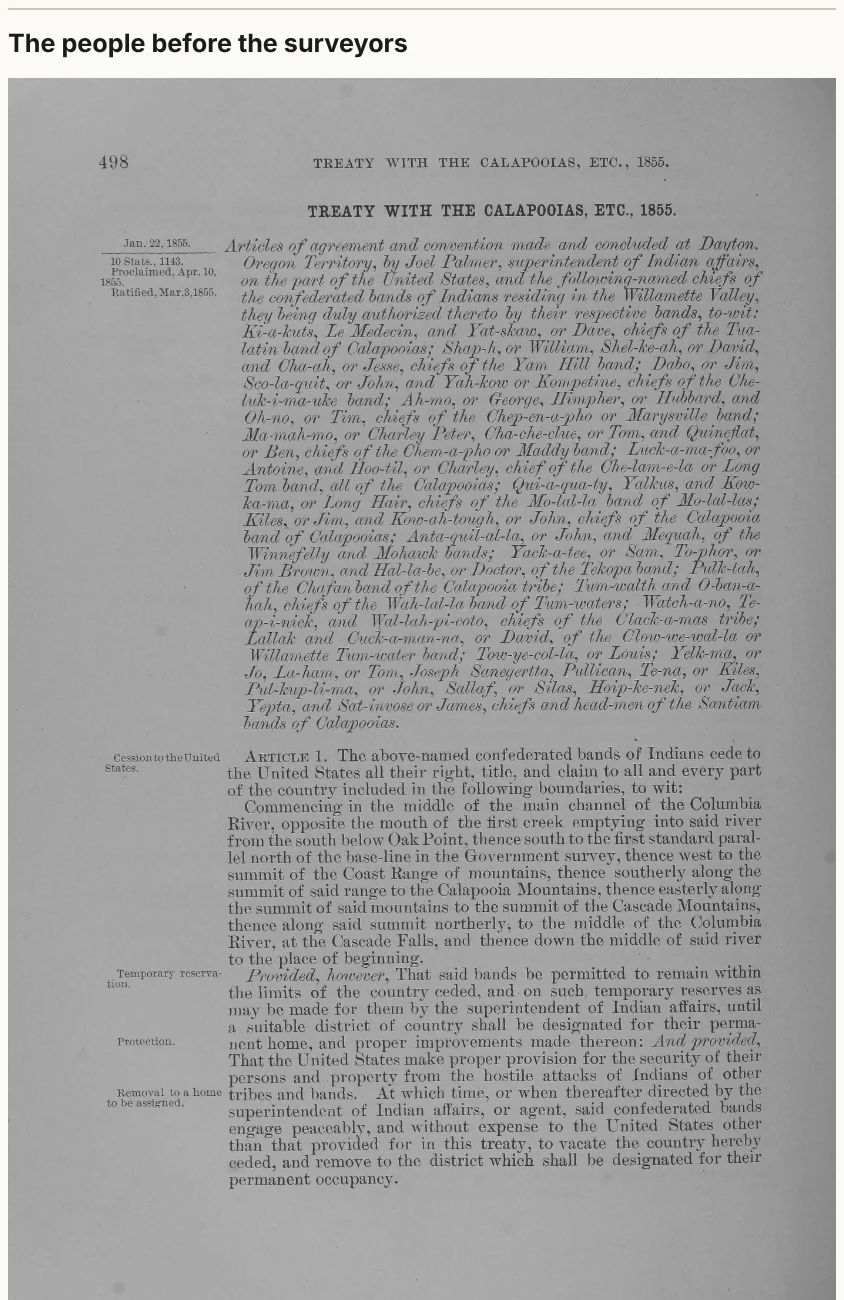
The picture. The first page of the treaty, from Kappler, through the Internet Archive.
If the part is folded. "The treaty that covers this land and the nations today are listed in the appendix." For much of Oregon the records that name individual people have not yet been read for every township (Part 5 says more).
In the sample report
Pedee sits on the Luckiamute River, home of the Luckiamute, one of the Kalapuyan peoples of the Willamette Valley. On May 1, 1851, at Champoeg, three men spoke for them: Daboe, or "Jim"; Scho-la-que, or "John"; and Yuh-kow, as one record spells their names. Federal commissioners asked them to move east of the Cascades. Scho-la-que answered that they "did not wish to leave the country where they had always lived." The Senate never ratified that agreement. The treaty that did take in this land was made at Dayton in January 1855, and the Senate ratified it on March 3, 1855.1
Notes
- Zybach, Soap Creek Valley study (1999), on the council of May 1, 1851; Kappler, Indian Affairs: Laws and Treaties, volume 2, treaty of January 1855 (10 Stat. 1143); as given in the sample report. ↩