
Chapter 18. What people remember, and what families keep
In a 1938 interview, a great-niece of the Pedee settler John Johnson recalled the family's crossing of the plains: "Father's uncle, John Johnson who had crossed the plains four times, was captain of the train. He had a place already located near Peedee for grandfather, James Taylor."1 A John Johnson, very probably the same man, held the land claim that takes in the east side of today's tree farm, and Taylor took the claim next door.2 Survey notes and patents could never tell you that Johnson chose a place for Taylor before the wagons arrived. A family remembered it, an interviewer wrote it down, and a volunteer cemetery record kept it. It is still a lead rather than a proof, but without the interview no one would know to look.
People who have known a place for a long time carry information that is written nowhere. They know where the old house stood, who planted the orchard, what burned in which year and what the creek did in the big flood. Records can wait in an archive for another 50 years. People cannot.3
Oral history
What it tells you. An oral history is a recorded interview with someone who remembers a place or a time, kept so that others can hear it later. It tells you what happened and who was there, in the words of someone who saw it, along with the things no one thought to write down.
Who to talk to. Earlier owners and their children. Neighbors of long standing. People who worked on the land or near it: loggers, farmers, foresters, road crews, mail carriers. Members of the tribes whose homeland it is, if they choose to share. Start with the oldest, and end every visit by asking who else you should see. Do not overlook yourself. If you have owned a place for 20 or 30 years, you are a source: write down what you remember, with dates as best you can give them.3
Before you record. Explain what you are doing and why. Say that you would like to record, what will happen to the recording, and who may hear or read it. Tell the person they can skip any question and stop at any time, and put the agreement in writing. The Oral History Association publishes the accepted standards, and the Smithsonian's Folklife and Oral History Interviewing Guide is a free how-to with sample forms. Permission to talk is not permission to publish.4
During the interview.
- Record the conversation; a phone is good enough. Begin by saying the date, the place and who is present.
- Bring things to look at: a map, an aerial photograph, old pictures. If the person is able, walk the ground together.
- Ask open questions. "What was here?" is better than "Was this the old mill?"
- Ask how the person knows. Did they see it, or were they told?
- For dates, ask about order. "Was that before or after the 1962 windstorm?" is easier to answer than "What year was that?"
- Let the person finish. Silence is fine.3
After the interview. Keep the original recording unchanged, and make a copy to work from. Type out what was said, or let a transcription program make a first draft and correct it against the recording. Give the person the transcript, the typed record of the interview, and ask them to check names, spellings and anything they want to correct. Note every correction as a correction. The recording remains the record of what was said.3
Check memory against the documents. Memory is strong on what happened and who was there. It is weaker on exact dates, and it tends to gather around a few large events. Take what you were told to the other records: a newspaper for the date, an aerial photograph for the place, a deed for the name. Bob Zybach's oral histories of Soap Creek Valley, north of Corvallis, show how. He chose people with first-hand knowledge, interviewed the oldest first whenever he could, and often met them at the places where events had happened. Tested against documents, their memories showed, in most instances, "striking degrees of consistency in detail."5 Where two people remember the same thing differently, record both accounts, and do not pick a winner without evidence.3
Give it a permanent home. A recording in a drawer will be lost. Ask your county historical society, the state historical society or a university archive to take a copy, with the person's written agreement. The Soap Creek Valley interviews are kept at Oregon State University, with some at the Oregon Historical Society, where anyone can ask to hear them (Chapter 25).3
What it costs. A phone or a recorder, the time to listen and type, and the cost of a copy for an archive. The standards and the sample forms are free.
A caution. A memory is a source, not a verdict. For years the tree farm's own management plan said the land "was homesteaded around the turn of the century." The patents show that homesteading accounts for about 7 of its 211 acres (Chapter 19).6 Check every story, including your own.
Family papers and photographs
What it tells you. The people who remember a place often hold its best paper records too: albums, letters, diaries, account books, old deeds, timber sale contracts and farm records.7 A family photograph can carry its own date and place. A cabinet card, a studio portrait mounted on stiff card and common in the late 1800s, usually has the studio's name and town printed on the mount (Figure 18.1).8 A working map can be a family record too. An aerial photograph with an owner's lines drawn on it shows how the land was seen and managed in one year (Figure 18.2).
How to go about it. Ask to see the papers, and ask before you copy them. Photograph or scan each item, record who owns it, and leave the originals with the family. The National Archives has a free guide, How to Preserve Family Archives.7
A caution. A family's papers belong to the family. A copy made for your research is not permission to publish.
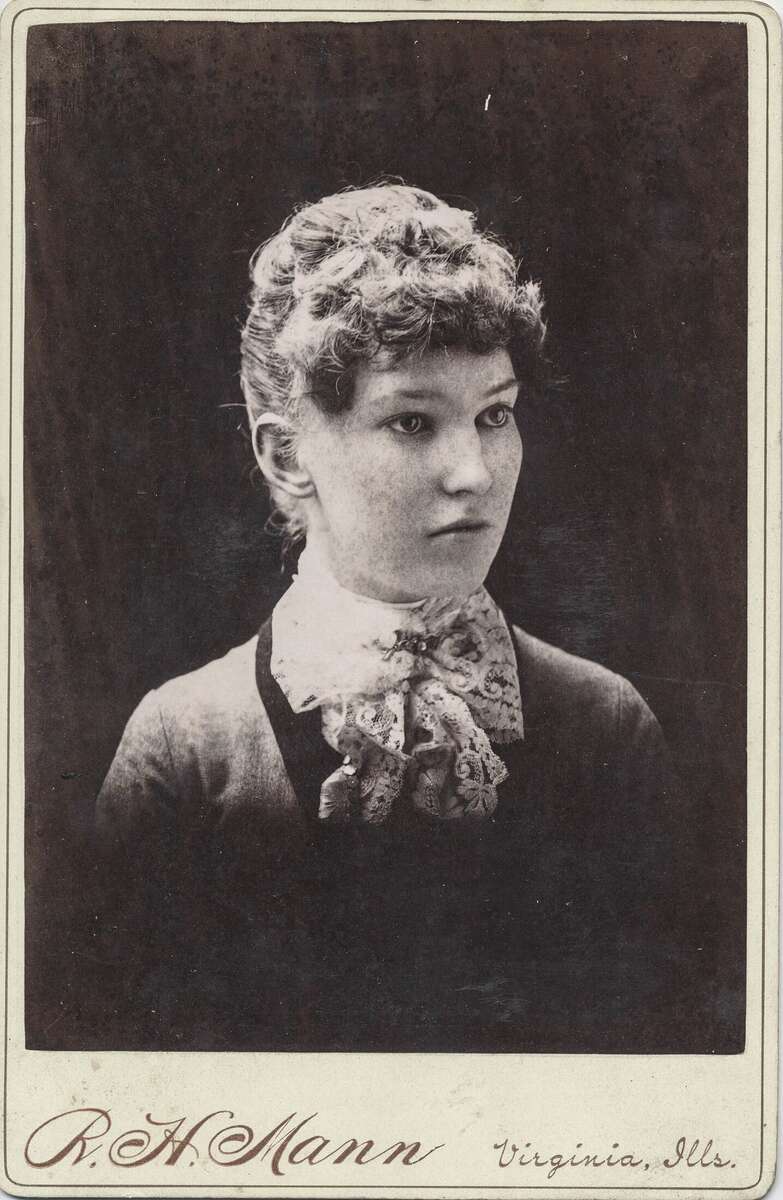
Figure 18.1. A cabinet card, a common kind of studio photograph in the late 1800s. Look at the bottom of the mount, where the studio printed its name and town: "R. H. Mann, Virginia, Ills." (Illinois). A line like that helps date and place a family photograph. Wikimedia Commons. Public domain.
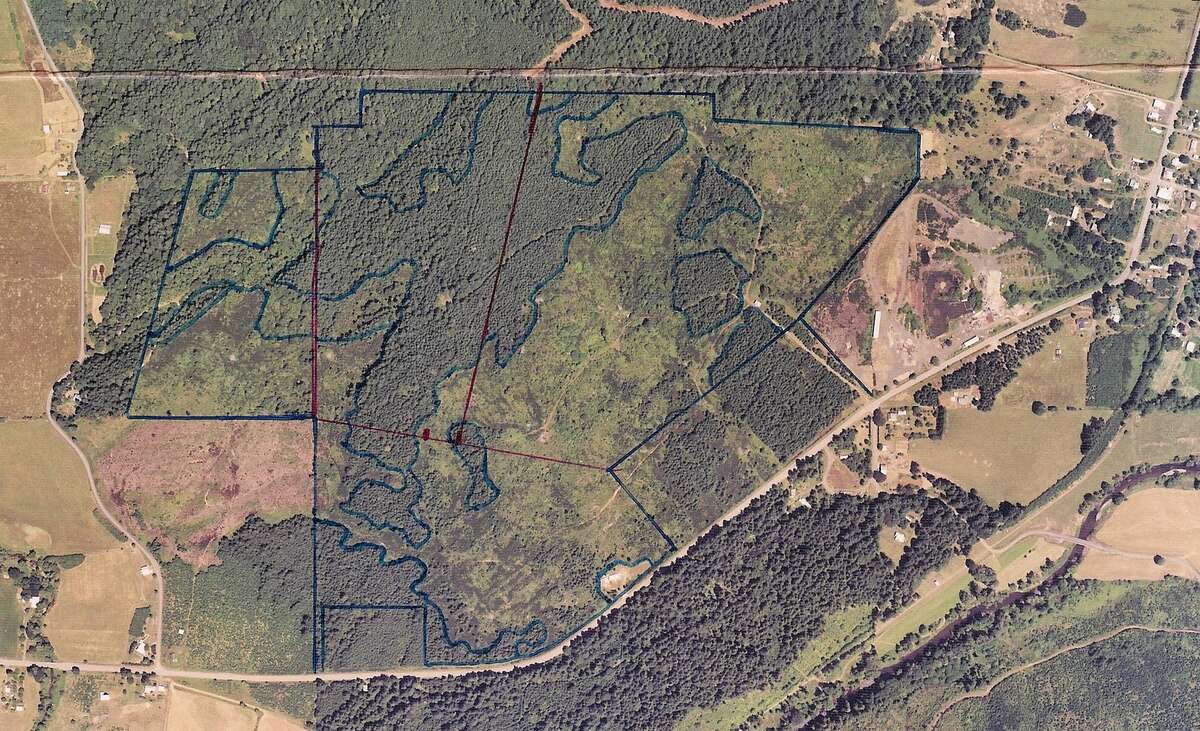
Figure 18.2. The Sullivan tree farm about 1997, with lines drawn by hand on an aerial photograph. Property lines and the edges of stands of trees are drawn by hand. The paler ground between the dark stands is probably land logged in 1989 and replanted in 1990. From the owner's files.
On the tree farm
The first interview to record on the farm is the owner's. Dave Sullivan bought the farm in December 1989 and has more than 35 years of first-hand knowledge of its land and its weather.9 His 2012 management plan already holds part of that memory, and other records bear much of it out. Before his time the whole property was fenced and grazed by cattle, and the 1955 aerial photograph shows open grassland. About 1976 Publishers Paper planted the open areas with Douglas-fir seedlings, each in a tube to keep the deer off. In the spring of 1989 WTD Industries logged nearly all the merchantable timber. In 1990 Dave Sullivan planted about 25,000 seedlings himself, and students from Oregon State University's floor-hockey club planted about 25,000 more.10 The farm's history also records a dirt-floored dwelling of about the 1930s, collapsed by 1990 and now lost under blackberry.11 That is the kind of detail an owner knows and a deed never mentions. The hand-marked photograph of about 1997 in Figure 18.2 is a family record of the same kind. Earlier owners, their families and long-time neighbors around Pedee come next.
Notes
- Polk County Pioneer Cemeteries, Taylor Cemetery records (polkcountycemetery.org), quoting a 1938 interview; as given in A History of the Land (2026), "The Johnsons."
- A History of the Land (2026), "1855: Two claims and two houses" and "The Johnsons." That the cemetery's John Johnson held land claim 53 is the report's inference, though a strong one.
- Zybach, B., How to Research Your Land's History, review draft, October 7, 2026, "Oral history and interviews."
- Same; Oral History Association, Principles and Best Practices; Smithsonian Institution, The Smithsonian Folklife and Oral History Interviewing Guide.
- Bob Zybach, Using Oral Histories to Document Changing Forest Cover Patterns: Soap Creek Valley, Oregon, 1500-1999 (MAIS thesis, Oregon State University, 1999), pp. 18 to 62; the quotation is on p. 59.
- Sullivan Tree Farm Management Plan (2012), as quoted in A History of the Land (2026), opening section and "1871 to 1900: Railroad land and a seven-acre homestead."
- Zybach, review draft, "Family papers and photographs"; National Archives, How to Preserve Family Archives.
- Zybach, review draft, "Family papers and photographs," Figure 45.
- A History of the Land (2026), opening section.
- Sullivan Tree Farm Management Plan (2012) and USDA aerial photograph of 1955, as described in A History of the Land (2026), "The twentieth century, seen from the air" and "December 1989 to today."
- A History of the Land (2026), "The twentieth century, seen from the air."