
Chapter 17. About this report: the appendix
Part 2. Reading your report.
The appendix is the bookkeeping, kept at the back so it never gets in the way of the story. Its heading is "About this report: what we looked at, what we didn't, and how sure we are."
The summary and the counts
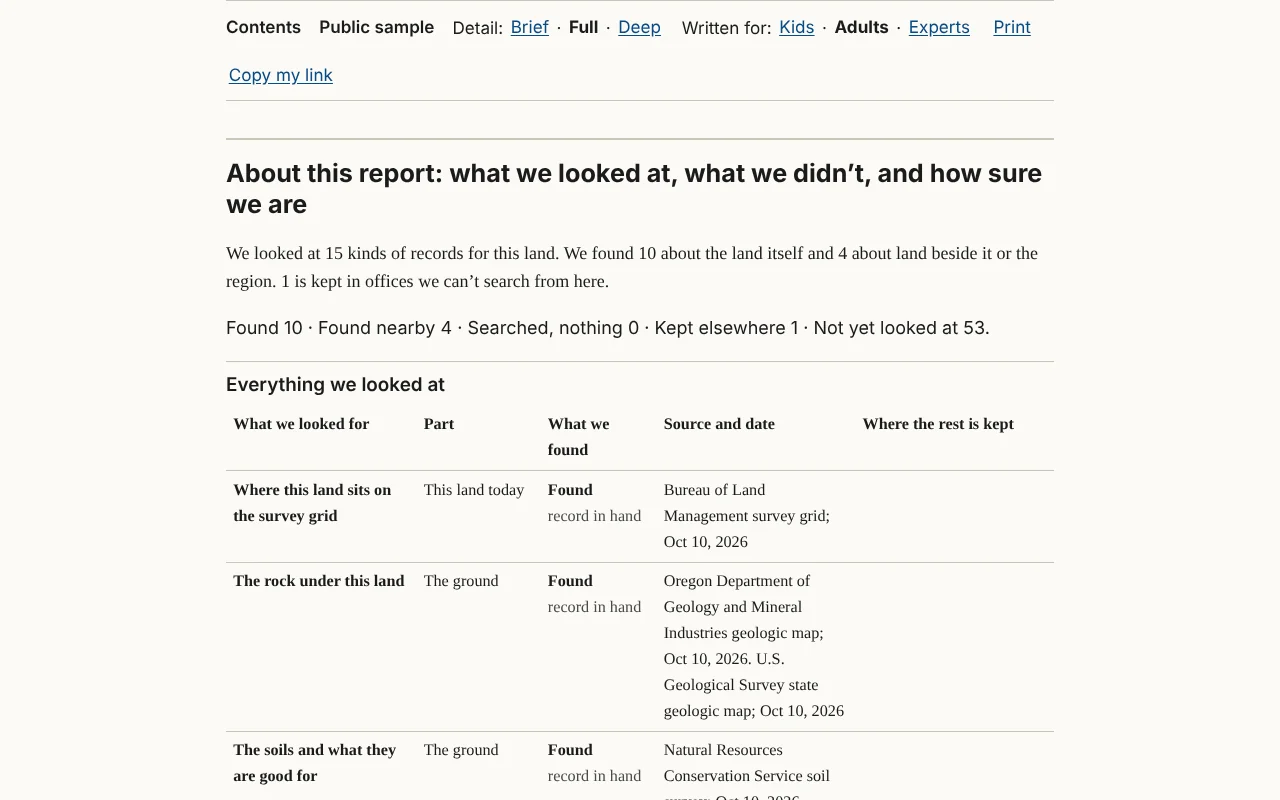
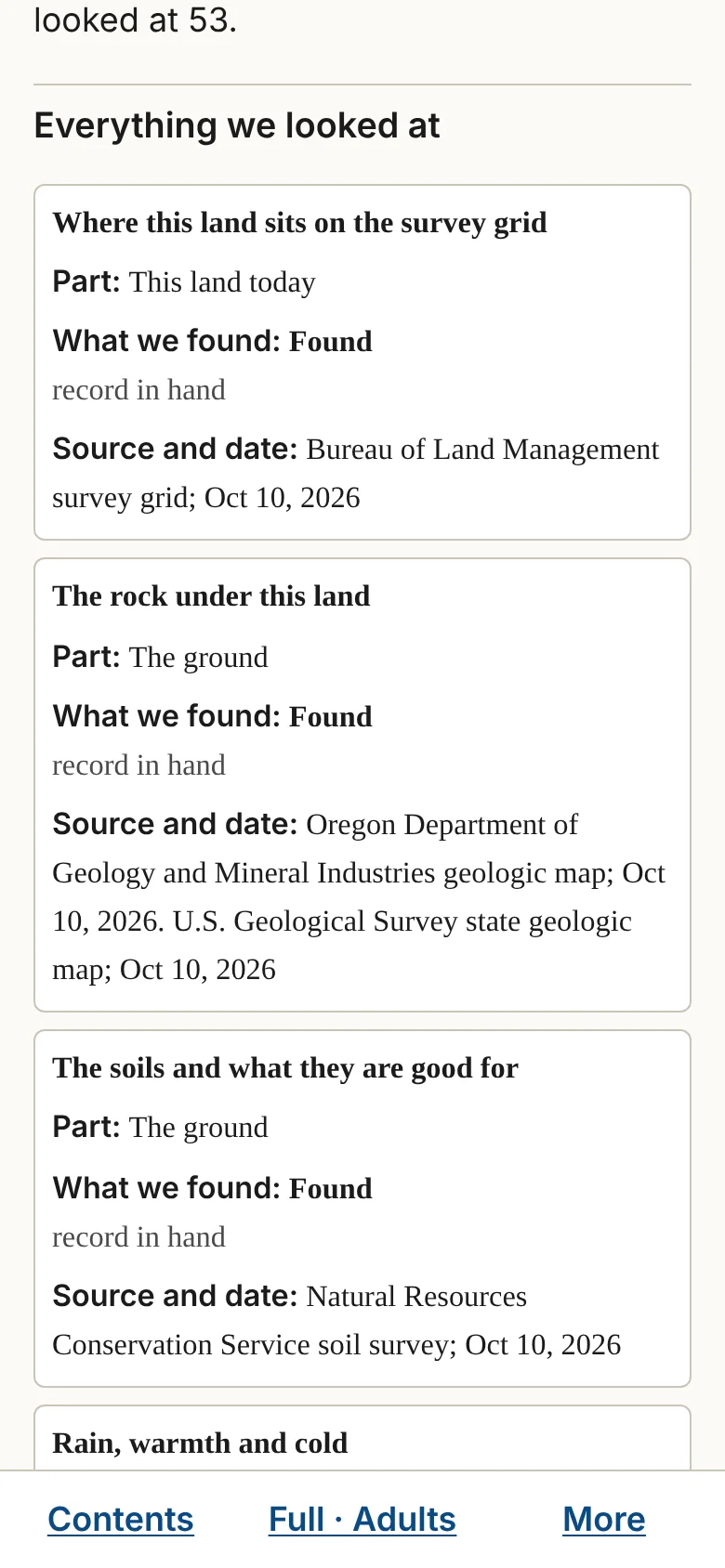
It opens with a few sentences of counts, such as the sample's "We looked at 15 kinds of records for this land. We found 10 about the land itself and 4 about land beside it or the region. 1 is kept in offices we can't search from here." A sentence whose count would be zero is left out. A line of five counts follows, the four status words and "Not yet looked at," such as "Found 10 · Found nearby 4 · Searched, nothing 0 · Kept elsewhere 1 · Not yet looked at 53."
Everything we looked at
A table with one row for each topic the report looked into, and five columns: "What we looked for," "Part," "What we found," "Source and date" and "Where the rest is kept." On a phone each row becomes a card. The "What we found" column uses four words.
| The word | What it means |
|---|---|
| Found | The record is in hand. A smaller label may say more, such as "record in hand." |
| Found nearby | The record is about land beside yours, about an earlier claim that included it, or about the region (labeled "regional"). |
| Searched, nothing | The source was searched and had nothing for this land. |
| Kept elsewhere | The site cannot reach the record from here: it needs a login, a fee or a visit, or the source was down. |
How to read the table. Read across a row: what the report looked for, where it looked, what it found, and where the rest is kept. Then read down the last column. It is your list of errands.
The other blocks
- Where the rest is kept: every place where more of your land's records are kept, each with its office, cost and hours, and on your own reports an Add to my research list button.
- Not yet looked at: the topics outside this report's depth. On your own reports each has Look into this, which starts that one search.
- How sure we are: one plain sentence for each caution the records carry, such as "The outlines on the old maps are placed by hand on the scans, so they are approximate." When two records disagree, this is where the report says so. When the surveyors' handwriting has been typed by machine, the first sentence here says so, once for the whole report.
- Sources, part by part: every source, with the number of records from each and the date retrieved.
The lines at the very end
The appendix ends with the line "Your Land History covers land anywhere in Oregon."; then two lines that end every report. The first says the report is history, not a title search: it does not show who owns the land today or where its legal boundaries lie; for that, ask a title company or a licensed land surveyor. The second says how the report was written. On your own reports it reads: "This report was put together and written automatically, using AI, from the public records it cites. No person has reviewed it." The sample's reads: "Most of this report was written automatically, using AI, from the records cited; the part about the people before the surveyors was written and checked by a person." The back of the report is the place to say these things once. Last come the version line, such as "Version 1, Oct 10, 2026.", whose number goes up each time a search adds to the report, and Forget this land, where it is offered (Chapter 24).
How much shows. At Detail: Brief the blocks are closed. At Full the first ones are open. At Deep all are open.
In the sample report
One caution in the sample's "How sure we are" is a disagreement between two federal records: the field notes date one survey to August 10 and 11, 1855, and the government's index says 1856. The timeline lists that survey under 1855, by the notes, and gives the index's year beside it.1
Notes
- The sample report, "How sure we are"; Hutchinson (1855), book D0022, page 351; BLM Oregon land records, survey index for the township, which gives 1856. ↩