
Chapter 16. If you're hooked: what to do next
Part 2. Reading your report.
The last part of the story is an invitation: three steps chosen for your land, and a fourth that is always the same.
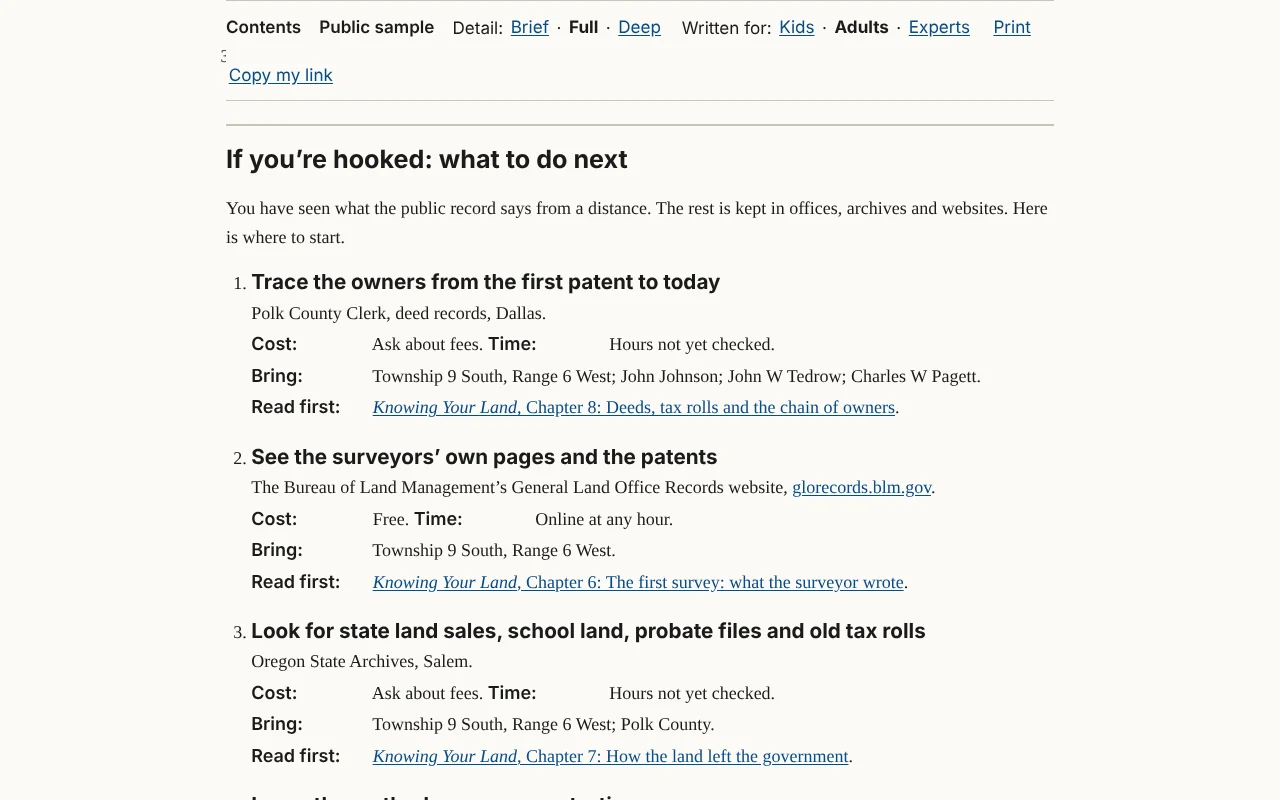
The steps. For most land they are: "Trace the owners from the first patent to today," at the county clerk's deed records in the county seat; "See the surveyors' own pages and the patents," on the Bureau of Land Management's General Land Office Records website; "Look for state land sales, school land, probate files and old tax rolls," at the Oregon State Archives in Salem; and last, "Learn the method, one source at a time," with Knowing Your Land.
What each step tells you. Where to go; "Cost:" and "Time:" (with "Ask about fees" or "Hours not yet checked" where the site has not checked); "Bring:", with your land's township and range and the names of its first owners; and "Read first:", a link to the matching chapter of Knowing Your Land. On your own reports, a step can have an Add to my research list button.
At the foot of the part, a line such as "More places for this land: 19, listed in the appendix, each with "Add to my research list."" leads to every other place the report found where your land's records are kept.
In the sample report
The first step sends you to the Polk County Clerk's deed records, in Dallas. Its "Bring:" line reads "Township 9 South, Range 6 West; John Johnson; John W Tedrow; Charles W Pagett": the names to look up in the deed index.1
Notes
- The sample report, "If you're hooked," October 10, 2026. ↩