Chapter 11. First owners
Part 2. Reading your report.
Most private land in Oregon left the United States by a paper called a land patent, the government's first deed. Land granted to the state, such as the school sections, passed to its first private owner by a state deed instead. This part names who got your land, when, under which law, and how many acres.
What it says. The patents on your land, with their dates, laws and acres; whether the land lies in a school section; at Full, every patent record found, with those for other land set apart.
Where the facts come from. The Bureau of Land Management's General Land Office Records, the federal database of patents, and the bureau's historical index for the township.
What to notice. The law named in each patent tells how the land left federal hands. In western Oregon the usual ones are the Donation Land Act of 1850, for early settlers; the Homestead Act of 1862; the federal land grants to railroads; and the grants to the state, including the school sections, 16 and 36 in each township. A patent's date is often years after the family settled, because the papers took time. A patent tells you who owned the land then, not who owns it now.
Beside this land. Patents for other land are listed under "Beside this land" or "Elsewhere in the same section," indented; they set the scene but are not about your land. In an area history of a whole section, every patent in that section is about your land and is shown in the main text.
In the sample report
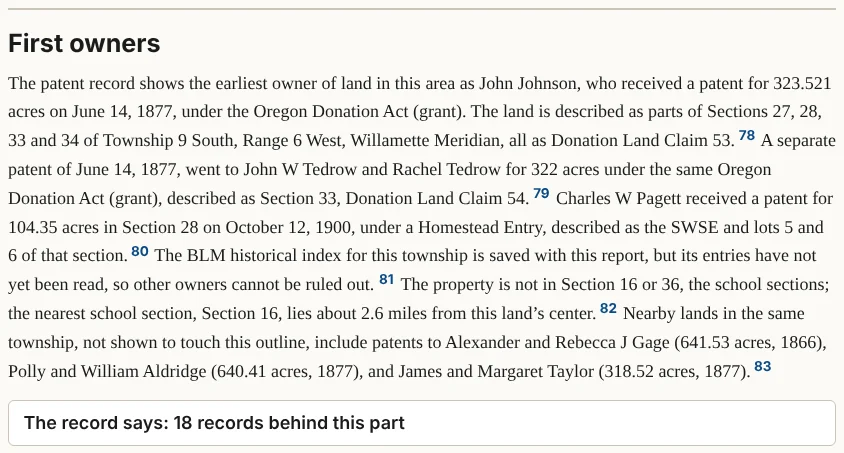
John Johnson and John W. and Rachel Tedrow received their land claims by patents dated June 14, 1877. The Oregon and California Railroad Company received patents in 1897 and 1899. The one homestead patent on the farm is Charles W. Pagett's, for 104.35 acres in Section 28, dated October 12, 1900. The farm is not in a school section; the nearest, Section 16, is about 2.6 miles away.1
From the farm's own history (not in the sample report)
The farm's management plan said the land "was homesteaded around the turn of the century." The records tell it differently. The farm holds only a strip of Pagett's homestead, about 7 acres along its north edge, and most of the rest came from the two 1850s land claims. Knowing Your Land, Chapter 22, tells the whole story.2