
Chapter 6. The record behind every sentence
Part 2. Reading your report.
Nothing in a report is said without a record behind it, and every record is one touch away. Sentences that rest on a record end in a small raised number.
Opening a record
Touch a raised number, or see the record after the opening, and the record panel opens directly beneath the paragraph (on a very wide screen, beside the text). The numbers are small, but the area that answers a touch is larger than it looks.
The panel is headed "The record says." It holds a picture of the record when the site has one, and then:
- What it says: the record's own words in quotation marks, or the site's plain wording of it. One of two notes may follow: "Typed from the handwriting by machine. Not yet checked by a person." when a machine typed it from handwriting, or "Our reading: worked out from the record, not copied from it.";
- Our reading: when the record's own words are quoted, the site's plain wording of them;
- About: what the record is about, such as "This land," "This section," "Beside this land" or "The township this land is in";
- Source: the agency or collection, and the record's own number, such as a field-note book and page;
- Dates: when the work was done, approved or indexed, and when the site retrieved it;
- Note: a caution that goes with this one record, such as "Reading needs checking.";
- Cite as: a full reference;
- buttons: Open at the source, which opens the record on the keeping office's website; Copy citation; That's wrong, for sending a correction (Chapter 26); and Close.
To close the panel, touch Close or press the Escape key. You return to the number you touched.
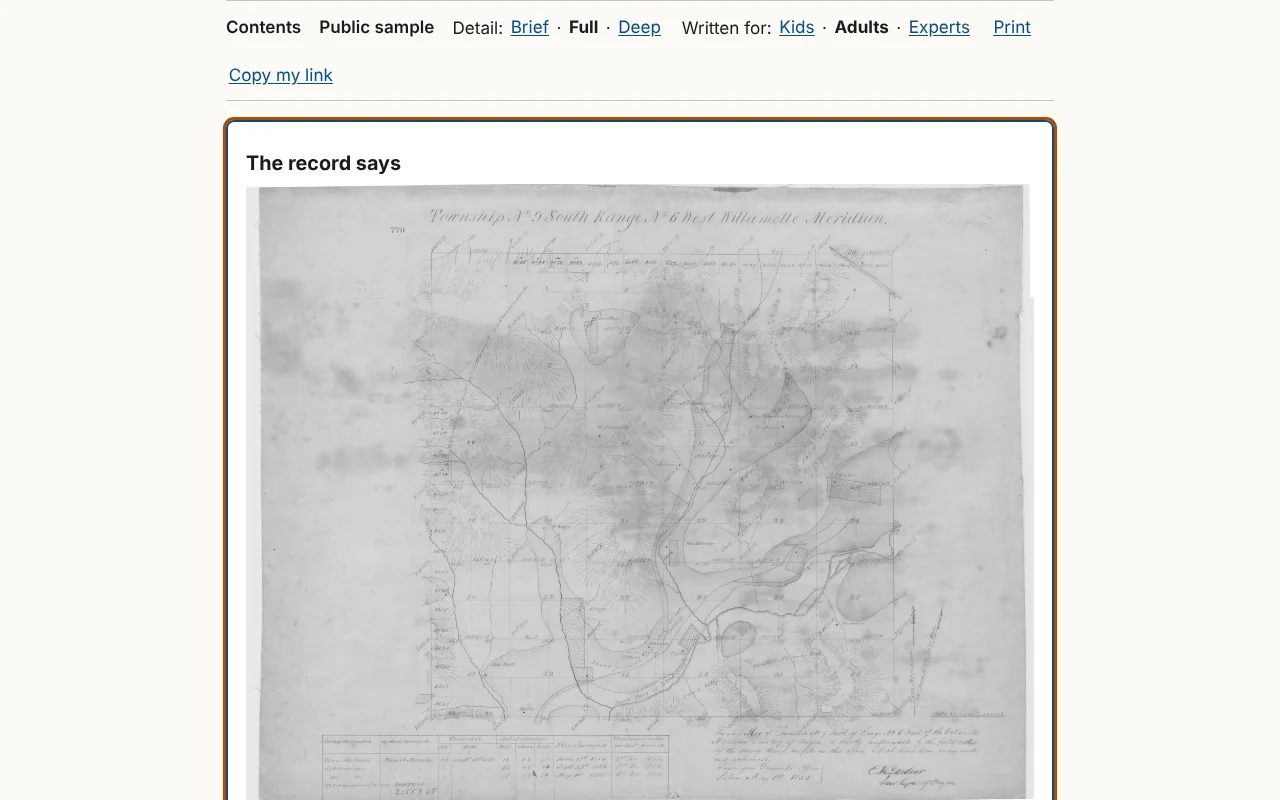
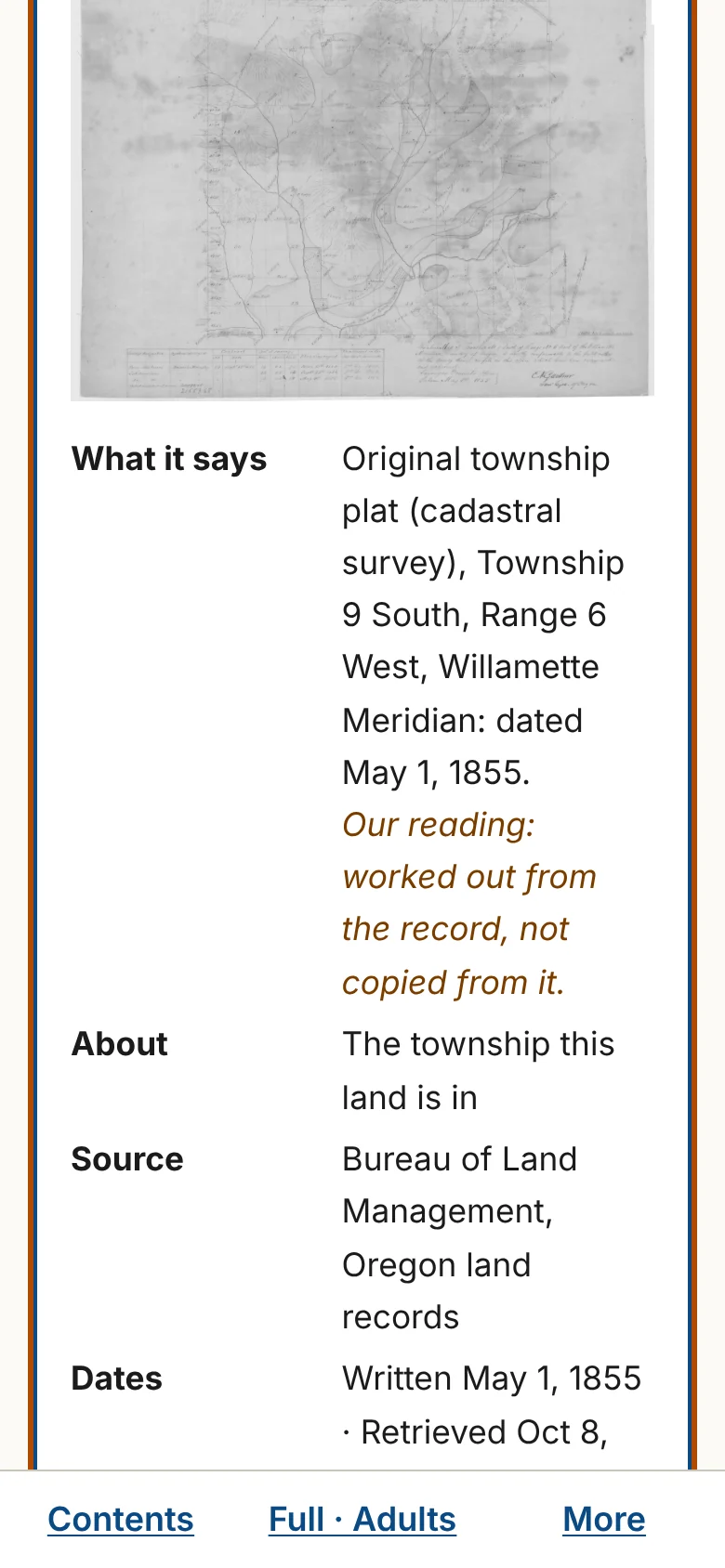
"The record says" at the end of each part
Each part ends with a closed block that reads "The record says: [number] records behind this part." Touch it to open the list of the part's records, grouped under short plain headings such as "The rock under this land." Records about other land are set apart under their own small headings and indented: "Beside this land," "Elsewhere in the same section" and "Around this valley." A neighbor's land claim can never be read as yours.
Pictures
Every picture has a caption that is always visible. The first line says what to notice; the second, in small type, gives the source. Every map shows your land outlined in yellow with a north arrow, and says "approximate," with its reason, wherever a line was fitted to a hand-drawn map. Touch an old survey map to open it full size.
In the sample report
In "The surveyors arrive," the first row of the table of corner trees is a white oak 20 inches across at the northwest corner of the Tedrow land claim, S 23° W of the corner post and 23 links (15 feet) away, from Thomas H. Hutchinson's field notes of 1855, book D0022, page 348. The sentence about that tree ends in a raised number. Its panel names the same source, and because a machine typed the tree from handwriting, it says so: "Typed from the handwriting by machine. Not yet checked by a person."1
Notes
- Thomas H. Hutchinson, field notes of the land claim surveys, Township 9 South, Range 6 West, 1855, BLM Oregon land records, book D0022, page 348; as given in the sample report's table of corner trees. ↩